

Ice Audio is a software house based in the south of France that aims to offer innovative plugins, preserving the analog tradition, with few parameters. Punch Maker was an unexpected surprise: you'll soon find out why!

Harmonic distortion has entered dozens of mixing plugins after a binge of pure digital. The beauty of analog has always been there: a little harmonic distortion, some dynamic compression, and a limited or modified frequency response. What seemed to be a limitation before the 2000s turned out to be an asset: the human ear really likes distortion because it manifests itself physiologically when listening at high levels. Adding harmonic distortion is a process that gives more body to the sound, draws attention, and enhances the timbre. Rock music as we know it would not exist without the distorted electric guitar, which thrives on distortion alone.
In recent years, the world of plugins has produced a series of emulations related to harmonic distortion (often linked to the Drive parameter) of classic preamplifiers, but what happens if a plugin allowed you to add the second and third harmonics at will, with a parallel saturator? It wouldn't have the same characteristics as a preamp, but it would still be flexible. And what happens if, in addition to harmonic distortion, it were connected to different bands, each with a different equalization profile? The answer can be found in Ice Audio Punch Maker.
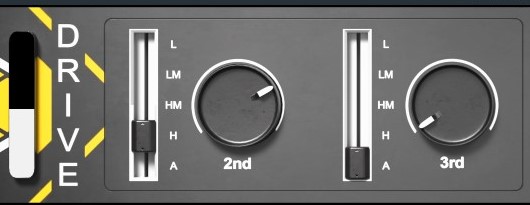
Controls
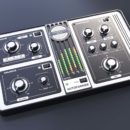
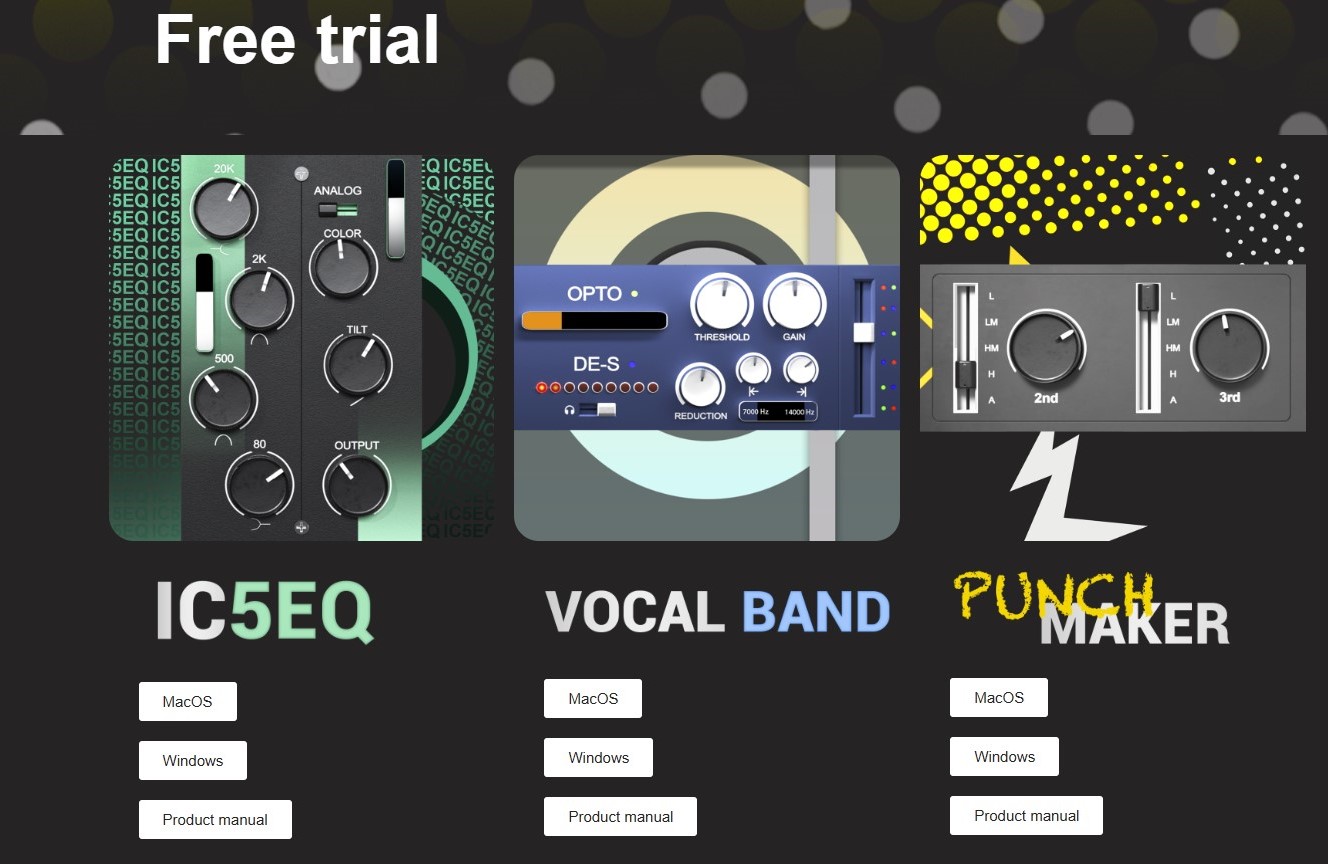
Punch Maker is simplicity personified: two controls for the second and third harmonic levels respectively, and two selectors to define the band, between All, High, High Mid, Low Mid, and Low (if anyone is thinking of SSL EQ, it's not too far off). Punch Maker also has a control dedicated to emulating a soft clipper, followed by an output control because adding harmonic distortion and, above all, inserting the clipper could result in the final level being too high or too low. Soft Clip parameter works as the clipper threshold.
It all seems very simple, and it is during mixing, but Punch Maker hides a few secrets. Let's start with harmonic distortion: here you will not only find the first series of even or odd harmonics, but all of them up to the end with gradually decreasing amplitudes. From a certain point of view, Punch Maker moves away from preamp emulation, but it is also true that by adding a little harmonic distortion, the levels of the subsequent harmonics are so low that they do not appear in the audio signal.

Analysis of the plugin shows that aliasing is present. We therefore contacted Thomas Delfini of Ice Audio, who confirmed that not only there is aliasing, but they deliberately kept it in order to produce a dirtier sound. The plugin works from 44.1 to 96 kHz, but there is no difference in aliasing.
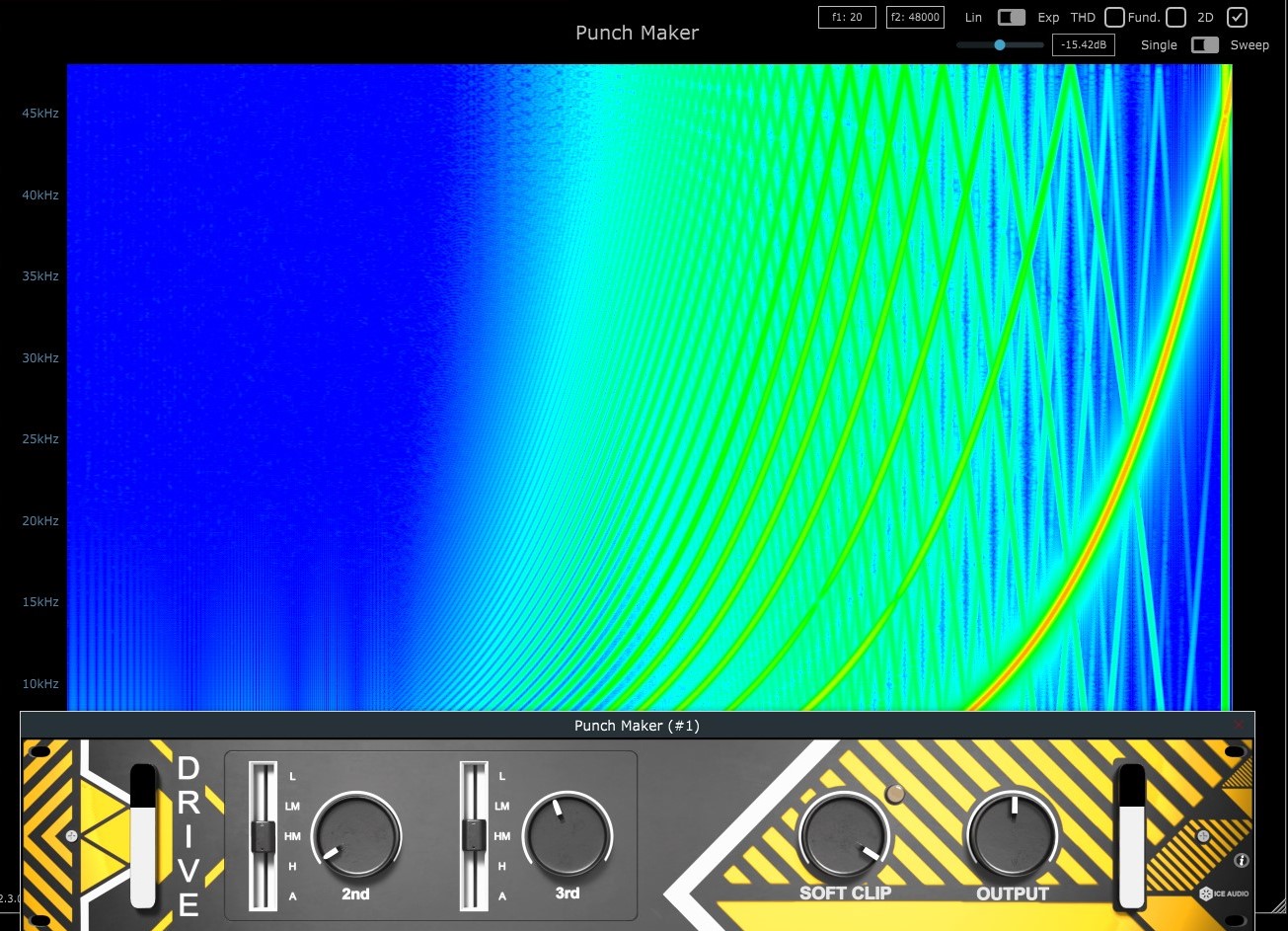
Aliasing in Ice Audio Punch Maker
Punch Maker's best-kept secret, which makes it unique among plugins, is its equalization. Apart from All, which leaves the frequency response unchanged, Ice Audio has included a different equalization for each band, with a curve whose amplitude increases proportionally to the level of the second or third harmonic:
Low 20Hz-150Hz
Low-mid 120Hz-1500Hz
High-mid 750Hz-4kHz
High 5kHz-20kHz
All 20Hz-20kHz
These curves have a unique feature, reminiscent of the SSL 292 equalizer (Pink EQ, on G series consoles) that we also encountered on the SSL Super 9000 channel strip: the curve has overshoots that allow for better characterization of the cut and leave space for other instruments adjacent to that frequency. The choice of equalization points depends on the band, and we can already anticipate that they are the ones you want to have during mixing. Furthermore, even with very high levels of second or third harmonics, the EQ never exaggerates with additional dB. The curve, in turn, also depends on the input level: the Q seems proportional to the level (similar to the SSL 292). The higher the level, the more the Q and overshoots increase. However, the curves are not standard: just by looking at them, it is clear that ad hoc programming has been done for each individual band:

Ice Audio Punch Maker, 2nd Low

Ice Audio Punch Maker, 2nd Low Mid

Ice Audio Punch Maker, 2nd High Mid

Ice Audio Punch Maker, 2nd High
By using different bands for the second and third harmonics, it is possible to obtain other equalization curves or, using the same band, a change in the curve can be observed, with greater amplitude and different Q values.
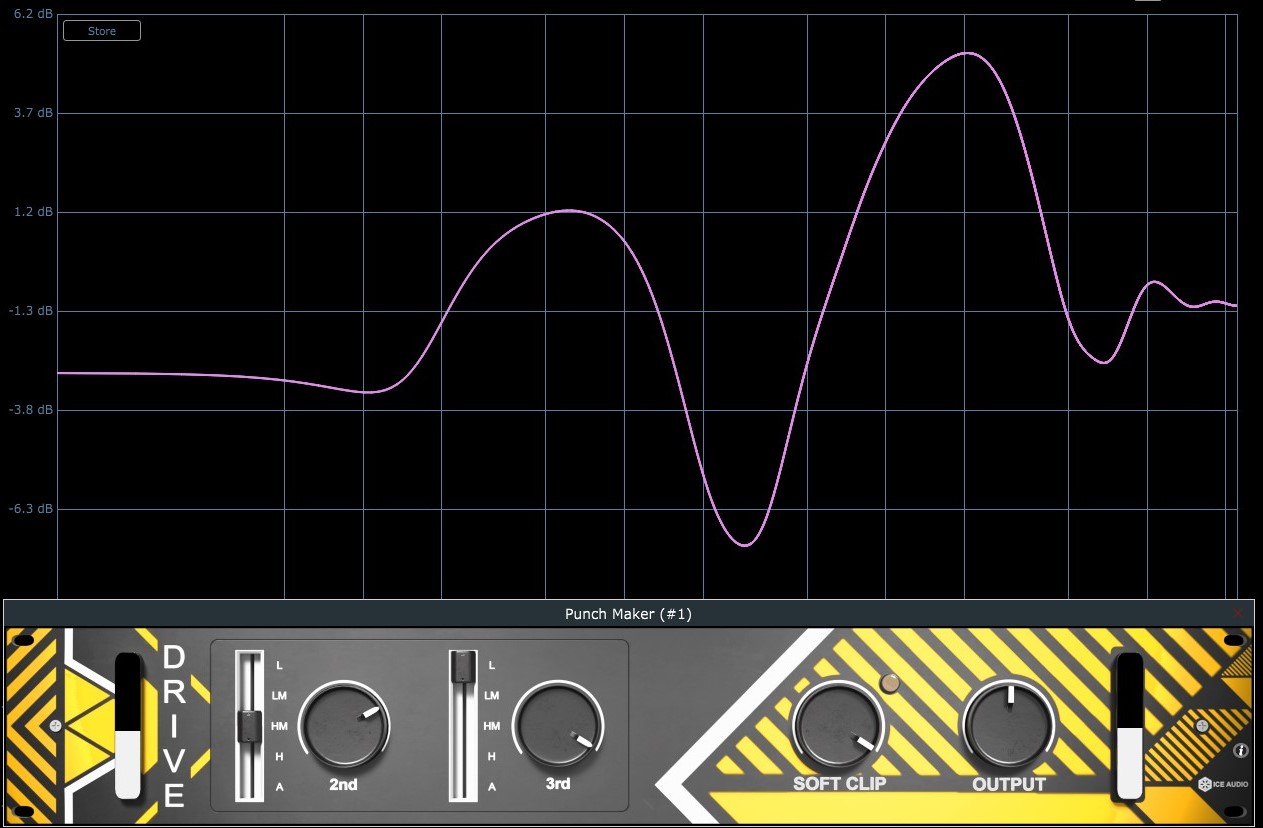
Ice Audio Punch Maker: la curva ottenuta con due bande differenti per 2nd e 3rd armonica
When using All, the insertion of harmonic distortion also involves a proportional increase in level, which must be taken into account during mixing. When selecting bands, on the other hand, only the amplitude and shape of the equalization curve change, but there is no proportional increase in level, except for a few dB, naturally excluding the equalized part of the sound.
Although defined as soft, the clipper is actually a perfect digital clipper, also with aliasing, with a clean cut of the attack and release portion. No peak or very fast transient escapes. It does not introduce any change in the frequency response: what goes in comes out cut with relative distortion due to the intervention of the clipper. Here, Output becomes fundamental as Make Up gain when the clipper is working hard.
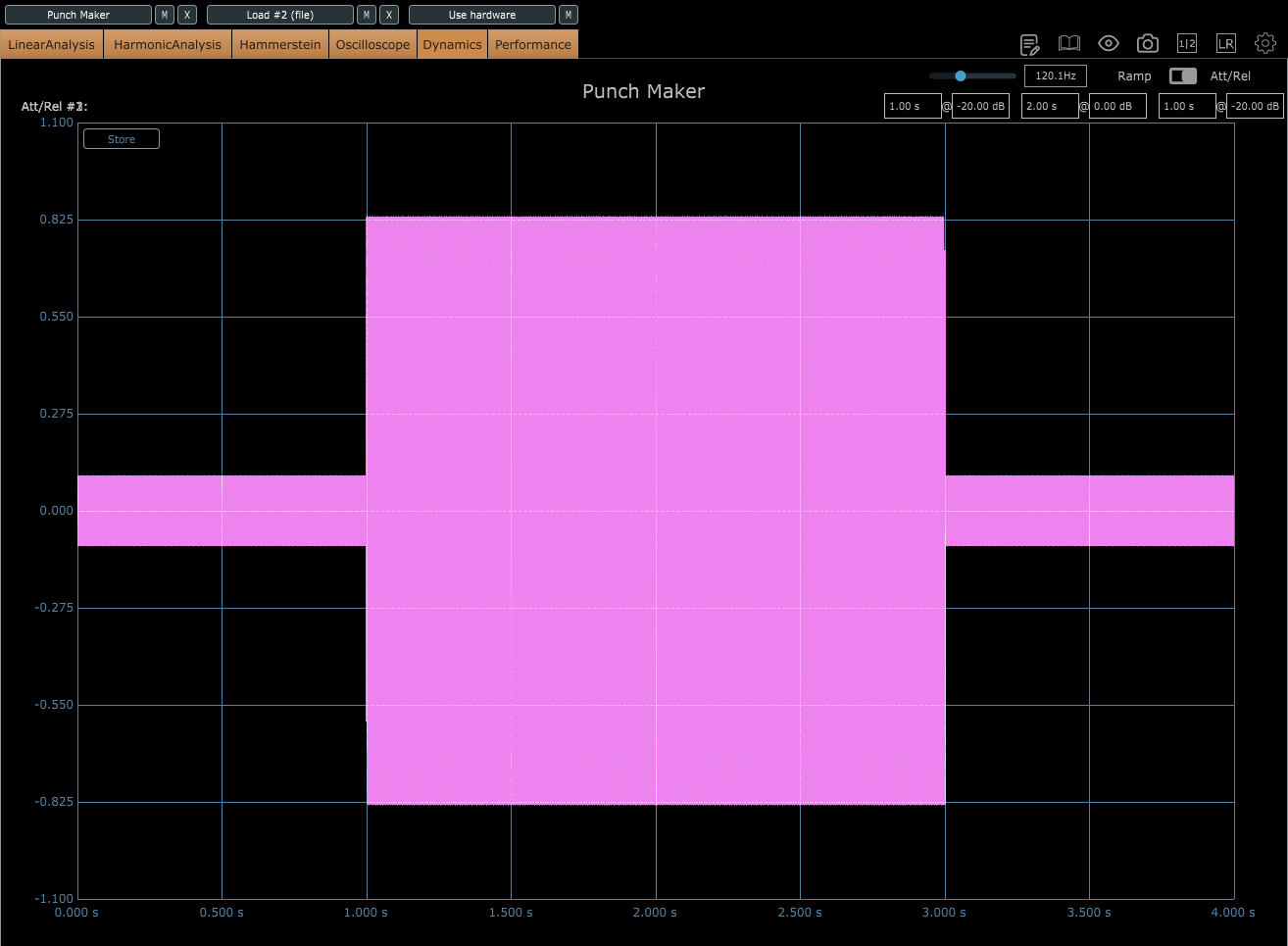
Ice Audio Punch Maker: attack and release of clipper

Ice Audio Punch Maker: some clipper curve
Field test
We had been looking for something like this for years: a plugin that would add harmonic distortion at will, between second and third harmonics, along with an integrated equalizer for individual bands. Punch Maker instantly transforms any track into a mix, improving it immediately. We used it, sprinkling it like salt on icy winter roads, on every track, and that's where we started.
We inserted it on the kick drum with the Low band and then enlarged the kick drum, giving it body, and there you have it! Before Punch Maker, we had an SSL autoDYN and an autoEQ, and the result was very very good. We didn't go easy on it: second harmonic at 11 o'clock on the Low Mid band and third harmonic at 2 o'clock on the Low band, with a touch of clipper. It came to life in just a few steps.
We moved on to the bass: second harmonic at 9 o'clock and High Mid band to keep the attack within the mix, third harmonic on Low with level at 8 o'clock: the bass became full-bodied and clear!
We got excited with the distorted guitar: the effect obtained is similar to Gyraf Infundibulum, the best passive multiband clipper for obtaining electric guitars rich in mid-high harmonics. The miracle also happened with Punch Maker, even more evident: we set the second harmonic at 3 o'clock on the All band together with the High Mid band on the third harmonic, at 4 o'clock, to give even more boost, and the result is spectacular! It's like having your ear pressed against the amplifier cone! The guitar stands out in the mix like a knife, without covering the vocals.
The vocals: we were curious, but then we simply thought about the mix. Second harmonic on All pushed to 1 o'clock and third harmonic on High at 9 o'clock The vocals came out of the mix and immediately carved out their space, forcing us to lower the fader because with All the level was higher than expected.
For the overheads, we looked for more punch: second harmonic on High at 3 o'clock and third harmonic also on High at 9 o'clock. In two seconds, we got the sound we wanted.
To get a punchy snare drum, we used the High Mid band on the second harmonic and the Low Mid band on the third for the drum room track, along with the snare drum head track with the High bands for the second and third harmonics. It took about two minutes and the sound was done.
We could go on, but experience has taught us to distribute Punch Maker across every single track and use it to carve out the sound between tracks and give it more depth. All this by following only the indications of the mix perception: no FFT windows, just our ears. And it works! In the end, the mix changed its face, becoming alive, present, illuminated, and without confusion on the tracks. We were amazed, to say the least, by the speed with which results are obtained. We would like to have other options, for example, parallel saturation with the original signal by applying equalization to the harmonics only, but that's okay. Aliasing didn't bother us in the separation of the tracks, which are perceived as more powerful and dynamic, but it's better to have no aliasing at all. We will wait for an upgrade in future, maybe with oversampling options. Despite treating about twenty tracks with Punch Maker, the LUFS shifted only slightly, as did the peaks. This left us more room to work on the bus and mastering, while still achieving a clear and powerful sound.
We used the soft clip very little, which is not a soft clip. It can be used to control the fastest transients, but its effect is felt with a flattening of the dynamics when it intervenes. It really takes very little.
Conclusions
Ice Audio Punch Maker is a plugin that will change your mixing life for the better: with just four controls, you can shape the tone of your track, making it more exciting and distinctive. It's one of those plugins that can go unnoticed in the mix by those who don't know it's there, because the result is so natural. It's addictive like few others and can be spread across all tracks in a template.
The price is ridiculous (only €45 on offer with an additional 10% welcome discount), considering the quality of the results and how easy it is to achieve them. There is nothing else like it, at least to our knowledge: Punch Maker is a hidden gem and can become the secret weapon for mixers, with a negligible investment.
For us, it was an unexpected surprise. A plugin we always wanted to have.
All you have to do is try the trial!